


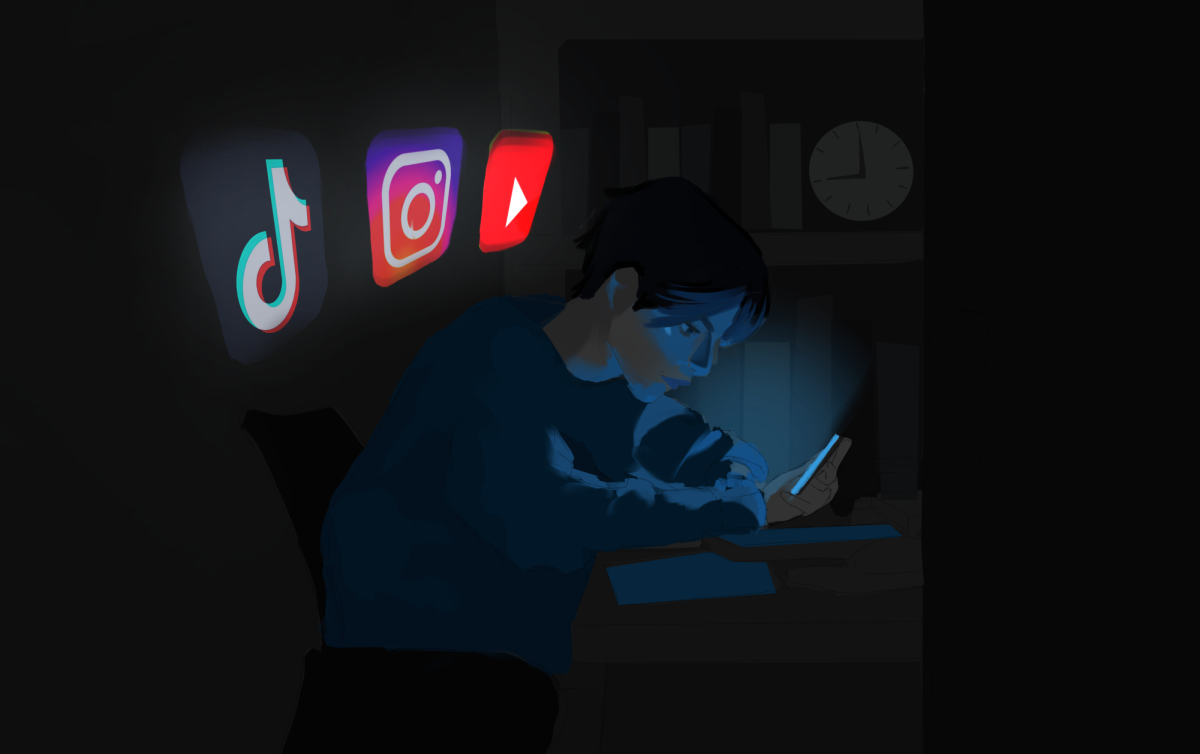
You have three quizzes tomorrow. You just finished your homework. You glance at the clock – 6:51 PM. “I’ll get started at 7,” you tell yourself. A nice, even time. Next thing you know, it’s 7:12. “Okay, 7:15, for real this time.” A few more rounds of “just one more reel,” and before you know it, it’s 9:00, and you’ve learned precisely nothing except how long you can procrastinate. So why are we doing it? Why are we scrolling for hours when we know it’s destroying our night and perhaps our GPA? The answer is dopamine.
Dopamine is not actually the “pleasure” drug that everyone makes it out to be. Dopamine is the anticipation drug. It’s activated when you are looking forward to something enjoyable. Every time you open TikTok, Instagram Reels, or YouTube Shorts, your brain goes on a small treasure hunt. Every scroll is an experience that could potentially surprise you with something funny, unexpected, or oddly pleasing, and that unknown feeling is what compels you to keep going.
You’re not addicted to the videos themselves; you’re addicted to the possibility that the next one will be even better. That’s the same psychological loop that keeps gamblers glued to slot machines. Social media made it simply free, portable, and disguised as taking a short break.
Compared to the excess dopamine granted from scrolling, learning does not provide an instant jolt of stimulation. There is no surprise, no immediate rewards, no slot machine payoff. It’s attention and patience, so your brain has to work much harder for the much delayed reward. When you are ready to study your notes or read a textbook, your brain does not get the immediate jolt of dopamine, so it assesses the task as boring and explores like a dog for something better, like your phone.
Here’s the kicker: restriction stimulates dopamine upon completion of the task. It’s a slow, but more impactful dopamine reward that comes directly from productivity instead of distraction. In fact, the very reward you study for from completion is a much more intense reward system. However, this can only be attained if you fight through the boring start of it all. That is why the beginning is always the hardest.
So, how should you start to work on this ever-so-frustrating problem? The answer is to train your mind to work for you, not against you. First, get your phone out of view. Do not panic or flip it over. It’ll be hard, but you should very simply walk to another room and put it away. The impulse and craving are much less intense when your brain cannot view the stimulation. Then, before you begin working, do nothing for five minutes. No music, no other devices, no distractions. This resets your brain’s reward system and makes studying feel less like punishment. When you do begin working, break tasks into infinitesimal, achievable bits. “Study chemistry for two hours” is unpleasant, but “do five flashcards” is manageable. Each small win gives your brain its own hit of dopamine, and that makes progress addicting in a good way.
The good news is that social media isn’t inherently bad, or it doesn’t have to be. It’s just designed to hijack your dopamine system. But you can hijack it, too. When you find yourself saying, “I’ll start at 7,” just start at 6:51. You’ll never be ready; but as soon as you begin, your brain will start to catch up. Scrolling feels good at the moment, but getting your work done later feels even better. The dopamine is delayed, but the reward lasts significantly longer.
Thompson, Sarah. The Science of Social Media Dopamine: Your Brain’s Reset Button. Ahead App, 6 Jan. 2025, https://ahead-app.com/blog/procrastination/the-science-of-social-media-dopamine-your-brain-s-reset-button-20250106-204932